Maintaining an indoor grow room needs precise control over humidity, light, and sanitation. Humidity levels often exceed 70% to 80% to support propagation and vegetative growth. Drywall fails quickly, while options like FRP create hidden maintenance traps. USA-made vinyl panelsare the superior wall material for grow rooms. Unlike drywall or FRP sheets, interlocked PVC panels create an impenetrable, water-resistant barrier that stops moisture infiltration, prevents mold growth, and optimizes grow light efficiency.
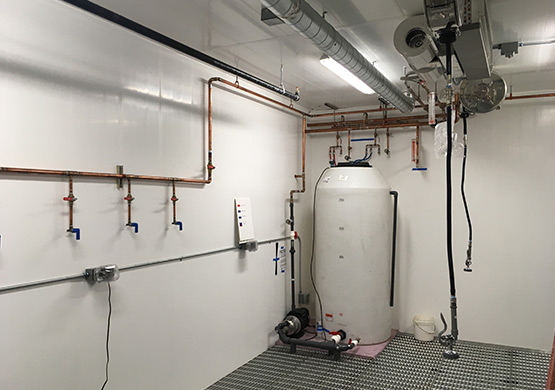
A Glimpse Into the Challenges of Operating Damp Grow Rooms
Indoor cultivation environments face extreme moisture pressures that quickly destroy standard building materials. Some of the main consequences include-
- Moisture Absorption- Drywall relies on paper backings and gypsum cores. Once humidity seeps into drywall, it softens, sags, and structural integrity collapses. This creates a breeding ground for crop-destroying black mold and powdery mildew.
- FRP Delamination and Trapped Moisture- Fiberglass Reinforced Plastics must be glued directly to an OSB or drywall backing using heavy adhesives. Over time, high humidity degrades the glue bond, causing FRP to swell, bubble, and delaminate. Water gets trapped behind the sheets, fostering hidden rot and mold colonies that spoil crops unnoticed.
- Sanitation Failure at Seams- FRP systems rely on exposed rivets and plastic division bars to join panels. These exposed trims collect moisture, dirt, and organic runoff, creating hotbeds for microbes that are nearly impossible to sterilize.
- Constant High Humidity and Washdowns- Grow rooms need frequent chemical cleanings between harvest cycles to eliminate pests like spider mites and mold spores. Wall materials that degrade under routine pressure washing or harsh sanitation chemicals result in costly downtime and constant repairs.
- Reduced Labor and Material Requirements- Installing FRP requires a complete layer of OSB or drywall, gallons of specialized troweled adhesive, and complex trim fitting. PVC panels install directly onto open wood or metal studs using basic mechanical fasteners. This cuts total installation labor time by up to 50%.
- Elimination of Replacement Downtime- Replacing moisture-damaged drywall or peeling FRP forces cultivators to take grow rooms offline, leading to lost harvest cycles. PVC panels are built to last for a decade, eliminating structural wall replacement costs over the facility's life.
- Minimal Cleaning- PVC walls wipe down in a fraction of the time needed for textured FRP or painted surfaces. Since vinyl panels do not absorb water, dirt, or grime, this makes cleaning easier with a simple wipe-down.
Do Vinyl Panels Repel Moisture?
Yes. Vinyl wall panels are highly resistant to moisture compared to FRP and drywall. Their non-porous finish doesn't soak up moisture, reducing the risk of damp walls and ceilings.
Are Vinyl Panels Easy to Recycle?
Yes. Vinyl wall panels are recyclable wall materials compared to FRP and drywall. They do not contribute to landfill waste, making vinyl panels environmentally friendly wall materials.
How Are Vinyl Panels Installed?
Vinyl panels feature a tongue-and-groove interlocking mechanism that lets them attach to studs. They lock together seamlessly without the need for wooden backers for support.
Wall Material Comparison- PVC vs. FRP vs. Drywall
| Performance Feature | Vinyl Wall Panels | FRP | Drywall |
|---|---|---|---|
| Water Resistance | 100% Water-resistant. Zero moisture absorption | Surface water-resistant. Backer board absorbs moisture | Water-resistant surface only. Core swells and rots |
| Substrate Required | Direct-to-stud installation. No backer board needed | Requires smooth drywall or OSB backer board | Installed directly on studs. Requires mud and tape |
| Joint & Seam Style | Interlocking tongue-and-groove; Smooth & hidden fasteners | Overlapping trims, division bars, and exposed rivets | Taped and mudded joints;Cracks under moisture strain |
| Mold & Mildew Risk | Non-porous surfaces results in mold and mildew growth | High risk behind panels due to glue failure | Very high risk. Organic paper feeds mold spores |
| Light Reflectivity | Excellent | Moderate reflectivity. Yellows over time | Low reflectivity. Requires specialized reflective paint |
| Lifespan | Last for a decade when properly maintained. will not rot or delaminate | 5 to 10 years before bubbling or peeling | 1 to 3 years in extreme high humidity |